
Warroad, 1968
Chapter 1. An excerpt from The Land of Everlasting Sky

This Tuesday, June 2, She Writes Press releases The Land of Everlasting Sky: A Memoir of Loss and Legacy on Lake of the Woods. Paid subscribers received the first ten pages of the first chapter during the past three weeks. Today, I am gifting all my readers the first chapter in full.
I stood there waiting in the gravel driveway, kicking dirt into dust clouds, surrounded by flat open fields six miles south of the Canadian border. Summer vacation with Mom’s side of the family felt like an escape from the heat and tension at home at the end of June 1968.
Grandma Kling came out Aunt Audrey’s back door with both hands full, carrying a tray of sweet rolls. She elbowed the front seat of her Buick forward and leaned into the back, where she slid the tray onto the rear window ledge. After we piled in her car, she looked over the seat and backed out onto Highway 313. Grandma tuned in KRWB-AM and pushed the lighter on the dashboard. Out of her purse she pulled a tube of primrose pink and her pack of Salems—same brand Mom smoked. Grandma applied a fresh coat of lipstick while glancing in the rearview mirror. She hummed along, tapping the beat on the steering wheel, and then lit a cigarette from the glowing red-hot coil. She turned onto Highway 11 past the Marvin Windows factory.
On the side of the road, I saw the sign: WELCOME TO WARROAD. WORLD CAPITOL OF WALLEYE, WINDOWS, AND HOCKEY. POPULATION 1,173.
Grandma turned left on Lake Street and drove through downtown. She pulled in and parked at the Warroad Memorial Hospital and Nursing Home. A solid gray bulk of a building, one of the few two-stories in town. It was where they sent the old, sick, and dying. I blanketed myself in the scent of cinnamon rolls in case it stunk of sickness and death in there.
We left the bright sunlight behind and slipped into the quiet and cool lobby. Dressed in matching seersucker shorts and tops Mom had sewn for us, my little sister and I held hands. Cousin Shireen held the door for Grandma Kling with her tray of sweets. We stood behind Grandma in front of the elevator doors.
When the doors opened, a wheelchair rolled out with an old man in it. I stared at the deep leathery wrinkles in his tan skin. He stared back.
Mumbling and grunting, the old man used his hands to direct the nurse who stood behind him to roll his chair forward through the gaggle of us three girls with our granny. The nurse situated him near the front door so he could look out the window. He muttered some more.
Shireen walked over to him. I followed, dragging Barb by the hand.
“You’re not getting any of my fresh-baked buns, Kakaygeesick,” Grandma clucked to our backs. Then she put her hand on her hip. Even though Grandpa, Harold Kling, had died, Emma Kling continued to do what she knew best: bake sweet rolls, take to heart the daily message of the Lutheran Hour on the radio, and tend to sick and dying friends and relatives. “Come on, kids.” She said it like she didn’t mean it.
The three of us stood in front of his wheelchair. He looked old—really old.
“These are my cousins, Jill and Barb,” Shireen said loudly, introducing us as if he were hard of hearing. Kakaygeesick looked at us. Shireen, age fourteen, the tallest with her carrot-red hair, me with mine straight brown, and Barbara Dawn, a six-year-old blonde.
He looked at me. Me in the middle. I felt no fear—pulled toward him by the magnetic force of his presence. He scrunched up his face and made even more wrinkles across his wide forehead. He caught my brown eyes in his gaze and held them. He leaned forward, picked up his large hands, and reached for my head. His smooth palms covered my ears. Be-boom, be-boom, beat my heart. Be-boom. He spoke low and slow. I didn’t understand a word, but felt his spirit enter me. His hands were warm and soft, and the heat flushed my head, neck, and shoulders, and moved down to my gut where I felt both his urgency and his sorrow.
I put my hands on top of his big gnarly fingers, and he pulled his hands back and folded them in his lap. He kept nodding at me, intonating his secret lament, as though I understood. My breathing slowed as I listened with curiosity.
“Come on, let’s go,” Grandma said. “I want to deliver these before they get cold.” The three of us skedaddled into the elevator. Barb got to push the button. Number two. Going up.
“Who was that?” I asked Grandma as soon as the doors closed. I could hear Shireen gulp as the floor began to lift.
“That’s Kakaygeesick. He’s sick,” Shireen volunteered.
“What’s he sick with, Grandma?” I asked.
“Old age,” she replied. The doors to the elevator opened, and in the lobby on the second floor there was a large oil portrait on the wall.
“Look!” Shireen pointed to the painting. “See? That’s him. ‘Kakaygeesick’ means Everlasting Sky.”
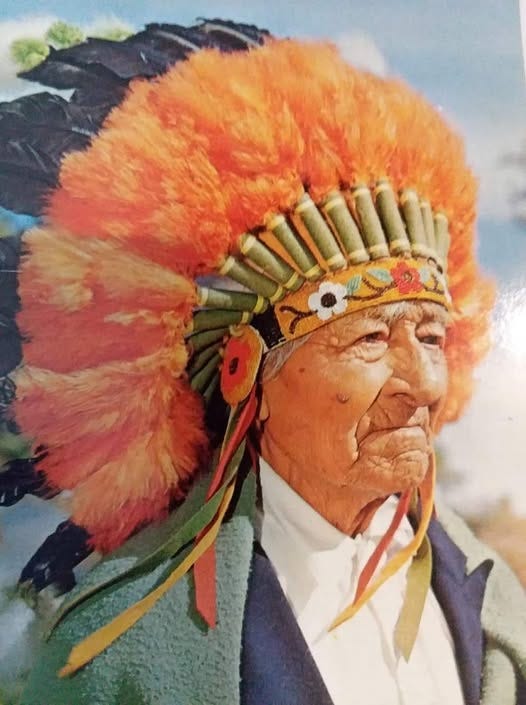
And there he was in full headdress, in silhouette, and without so many lines on his face. A headdress with black crow feathers and the downy tufts of the white partridge. Across his forehead, he wore a leather band with beadwork. The portrait didn’t really look much like the old man wearing a plaid shirt and navy-blue pants in the wheelchair downstairs. I read the small plaque on the bottom of the wooden frame: KAKAYGEESICK. BORN 1844 ALONG THE SHORES OF LAKE OF THE WOODS. TRAPPER, MEDICINE MAN, AND TRIBAL LEADER OF THE OJIBWAY.
I had to do the math, subtract 1844 from 1968. That makes him one hundred and twenty-four years old. I didn’t know what he had said to me, but I felt his story caught between my ears.
“Don’t fall asleep,” Shireen whispered. She turned off the light and crawled into the double bed with me. We could hear our parents talking and laughing in the living room. Mom and Audrey sounded so much alike we couldn’t tell who was saying what.
“Watch the sky in my mirror,” Shireen said. She pointed to the foot of the bed, where a large looking glass hung above the built-in set of drawers and said, softly, “When you can see the colored lights reflected, it’s time for the show.” She lay down and pulled the sheet up to her chin.
My eyes adjusted slowly to the darkness. Above our heads was a window as wide as the bed. Lying on my back I could see the mirror just over the tips of my toes. It was a long time before I saw something glow in the mirror.
I sat up in bed, turned around, and knelt before an altar of the night sky. As I pressed against the window screen, the hatch marks disappeared from view. I knelt on the pillows and rested my elbows on the windowsill. Staring at the horizon of pine trees along the hedgerow, hues began to dance. Streaks of green, blues, and lemon yellow jumped the horizon. Flashes of reds and oranges, lime streaks against a purple haze. The North Star and the outline of the Big Dipper popped out against the black moonless sky.
Shireen sat up, turned around, and knelt with me—elbow to elbow—silently staring out the window. Watching the earth’s undulating energy, I felt goose bumps on my skin. On a small swatch of land between the highway and the railroad tracks, I witnessed the mystical aurora borealis.
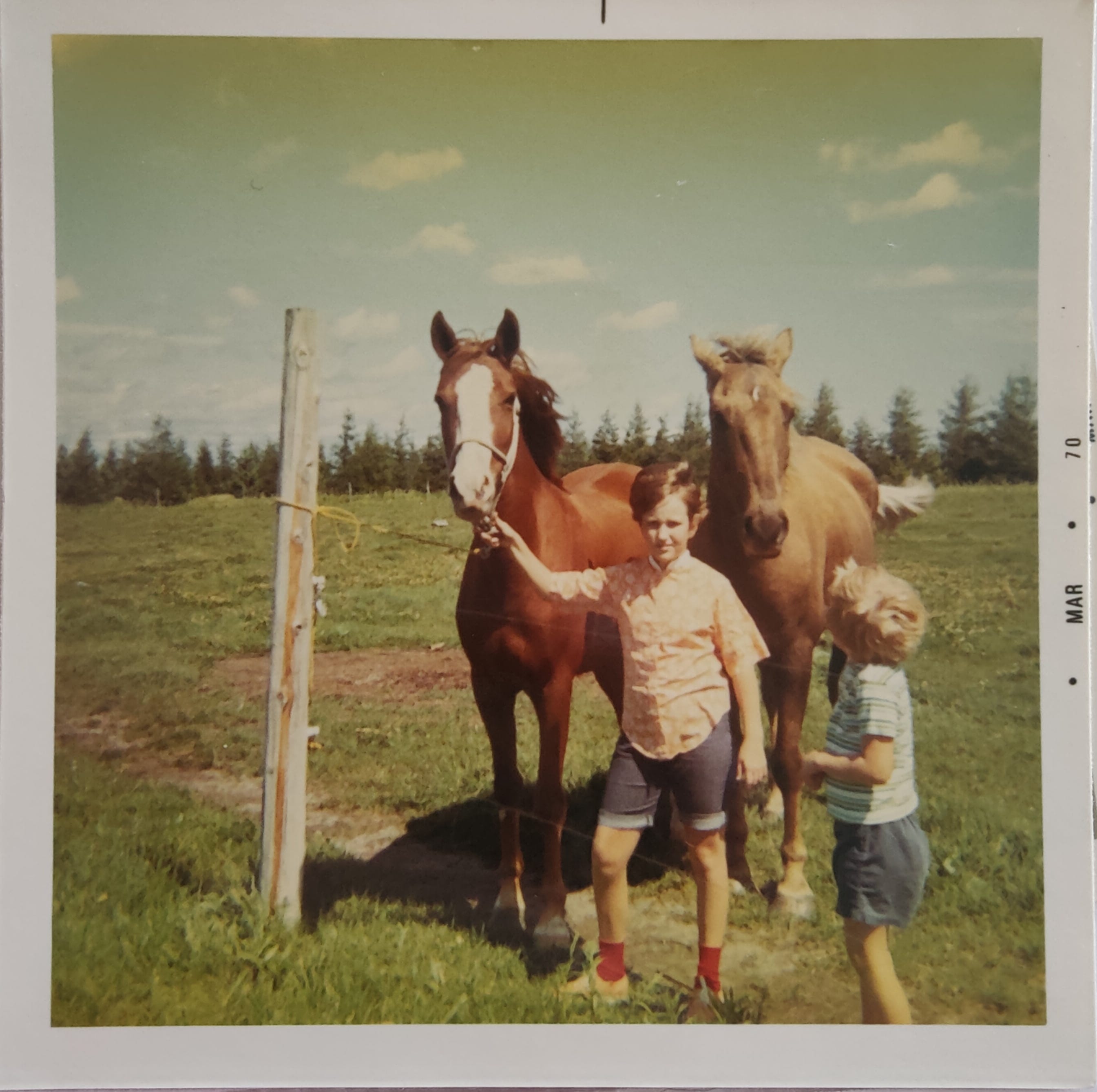
Shortly after dawn, my head popped up, and I opened the window where the northern lights had danced the night before. In the paddock stood Shireen’s mare, a red quarter horse. Beebe stomped her feet but did not move. She flicked her tail, shooing the big black deerflies. I watched the cat disappear down a row of beans in the garden. Only then did I notice my tall, lanky uncle squatting in the garden, down deep on his haunches. Chest and thighs touching, his butt rested on the back of his black leather boots. Still and centered, he pulled weeds.
On CBS Nightly News I’d seen people squat like that in rice paddies somewhere in Vietnam. Down so low to the ground you hardly saw them. They wore big round hats to keep the sun from their eyes. Helicopters and machine guns provided the soundtrack. People in their straw hats gunned down and killed. Uncle Al servved in the Army during the Korean War, Mom had told me. Then she’d said not to ask him about that.
I watched while Uncle Al worked silently down the row. He had a pan he pulled along with him. He grabbed weeds by the roots, gently pulled, and laid them down to die. From the pan his fingertips slipped something into the ground where he’d pulled the weeds out. He had been out on the lake already and fileted his catch in the garage. I knelt at the window and watched him bury the guts in the bean patch. The cat kept trying to lick the pan, and he stroked its tail instead of pushing it away.
As if he sensed someone watching, Uncle Al turned around and looked in my direction. When he saw me in the window, he gestured for me to come out to the garden. I quickly dressed in jeans and a T-shirt. As I headed out the back door, Aunt Audrey handed me two empty one-gallon plastic ice cream buckets. She had already put the coffee on the stove to percolate. Mom and Dad were still asleep on the hide-a-bed in the living room. I quietly let myself out the back door and walked out to the garden in my flip-flops.
“Do you know how to pick peas, Jill?” Uncle Al didn’t expect me to answer even though I was almost ten years old. He showed me with his hands. He pushed before he pulled the pea pod loose from the vine. Then he dropped the pod into one of the ice cream buckets. He showed me again, tenderly grasping the plant first with one hand. Then with the other, he took hold of a pod and pushed it toward the plant before gently pulling it back and free.
I pushed the pod toward where it attached itself to the vine and tugged. It popped off into my hand. I looked at Uncle Al’s hands. Long fingers, tender pink palms, and weathered knuckles. I watched how he touched them. He cupped his fingers around the pod to see whether it was full or flat. Sometimes he released his grasp because it wasn’t ready. He saw me watching and stopped to inspect what I had put in my pail. He opened a pod to show me the size of the peas. Running his thumbnail along the seam, Uncle Al split the shell open and shoved the peas into his mouth. He smiled. Then he popped open a pod for me.
Better than a Pez dispenser. Sweetness and green. He smiled back at my happy face and showed me again without saying a word. Then we walked back to the house. I already knew he had to go be postmaster in town. He’d be back for the lunch hour— if not to eat—perhaps to mow the lawn.
Shireen had prepared bowls of shredded wheat with strawberries from yesterday’s pickings. I poured fresh milk over mine, sprinkling a tablespoon of sugar on top. When we’d slurpled the last drop of sweet pink milk from the bottom of our bowls, Shireen washed the breakfast dishes while I wiped them. Then we went out to tend to her horse. She brought the strawberry scraps and some carrots along.
“Don’t touch the electric fence. It’s on,” Shireen said, as I ran ahead of her walking across the lawn toward the horse pasture. “Let me shut it off.”
She switched it off, then slipped between the two strands of wire fencing. I followed after her, and we made our way to the shed; it wasn’t really big enough to call a barn.
“You can be my shadow, Jill,” Shireen said. She gave Beebe the berry scraps and gave me the carrots to hand-feed her while Shireen used a curry brush on the horse’s sides. When Beebe finished chomping down the carrots, Shireen handed me the brush. “Give it a try.”
Copying Shireen, I took the brush in my right hand and made small circles on Beebe’s girth. My left hand rested behind her shoulder, where I felt her breathe. The horse leaned her weight ever so lightly against my right hand stroking her side.
Shireen grabbed a halter off a nail on the wall and put it over Beebe’s head and nose, then attached a long lead. While we walked her around the paddock, Shireen let me hold the lead. She filled the grain bin and filled the trough with water from the garden hose.
“I like you sharing chores with me,” she said, looking down at me with a smile. “Makes things easier around here.”
I learned how to use a pitchfork cleaning out the manure from the stall. I hoped maybe she’d let me ride her horse sometime soon.
The rest of that morning we spent picking the eight rows of peas and talking about horses.
“Good job, girls!” Mom was thrilled to see our full pea buckets when we came in for lunch. She ushered us to chairs at the dining room table as though we were special guests. Even offered us dessert after we ate our grilled cheese sandwiches and tomato soup.
While Aunt Audrey and Mom lingered over coffee and strawberry rhubarb pie, Shireen and I shelled peas at the table the rest of the afternoon. The pods went in one bowl, the peas in the other. Barb played with her Skipper doll. Dad slipped away to the trading post in town for more postcards, some souvenirs, and then to the Main Street Bar & Grill, where he’d meet Al after work for a beer with his buddies. Hamm’s on tap.
Waiting for the men to come home from town, Mom, Aunt Audrey, and us girls noticed a dark figure approaching the house across the three acres of lawn. We got up and looked out the picture window in the dining room.
It wasn’t a horse, I realized quickly. It was much bigger. A moose!
He walked right up the concrete steps to the front door and pushed his nose on the doorbell. Ding-dong. Nobody ever used the front door except the Avon Lady. The moose leaned his big head and antlers against the picure window of the dining room. For a moment, I feared he’d bust it. Blackie barked. Then the moose tipped his head down and looked right at the dog jumping at the lower ledge of the window. Blackie turned tail and hid under the dining room table. The moose backed down and headed around the side of the house. Shireen and I ran to her bedroom window and watched it tromp through the garden and take out most of what was left of the pea plants.
Beebe didn’t pay it any attention until she smelled the crushed pods. Then her head popped up.
We heard the car pull into the driveway, and the moose trotted off through the hedgerow. Uncle Al and Dad came in the back door.
“Dad, Dad!” I shouted. “Did you see it?”
After pan-fried walleye filets, boiled potatoes, fresh-baked bread, and steamed sweet peas smothered in butter, Shireen and I did the dinner dishes and got into our pajamas early in hopes of seeing the northern lights again. We each had a dish of ice cream sprinked with Nesquick chocolate milk powder before bed.
Darkness enveloped me like plush black velvet. Clouds obscured the stars from view. Night crept inside and brought a deep stillness. A streak of chain lightning flashed with a simultaneous rumble. The patter of rain kept a steady beat. My breath slowed, and the lids of my eyes lowered.
The map of North America on the wall to the right of the mirror seemed to glow. In my dreams, I was swept up in a storm, with lightning and thunder, swimming and flying with fishes and birds, the currents pulling me along. I had seen the outline of what the Ojibway creation story calls this continent: Turtle Island. The right back leg was Florida, with toes of islands. The left hind leg was Mexico, with Panama for a foot. The round shell covered the land, and its fluttering right claw, Canada’s Baffin Island, reached out into the North Atlantic. Turtle’s left front flipper rose up out of the Rockies and reached past the Yukon of Alaska. Its head bobbed in and out of the Arctic Ocean, and its nose pointed toward Greenland. The currents and tides swirled around thousands of isles in the Canadian North Country. The beating of my heart became one with the patter of raindrops.
Half-awake, I heard Shireen sleep soundly next to me while the map swayed like a hallucination on the wall. Her breathing slowed down my racing heart. I retracted my head into my shoulders and stretched the cool white sheet over my head.
Snap! Snap! We rubbed stones across the dots on the red tape of the cap rolls to make them pop and smoke. We had the ammo, but no toy cap guns. Dad had promised us sparklers. If we were good.
“Good” meant washing the lunch dishes, taking out the garbage to the burn barrel, hanging wet laundry on the clothesline, picking beans from the garden. “Good” meant waiting without whining. And no sass.
Grandma had spent much of the day sitting on Aunt Audrey’s hide-a-bed crocheting squares in rainbow colors framed in black acrylic yarn. She worked a pattern more intricate than the God’s Eyes we’d made at Bible camp from two sticks crossed and wrapped in scraps of yarn.
“Do you think you’d have time to perm my hair next Wednesday?” Grandma asked Aunt Audrey.
I looked at Grandma. Her dark brown hair looked speckled salt-and-pepper at the roots.
“Sure, Mom. I’ll pick up a perm and color rinse at the pharmacy,” said Aunt Audrey.
“They’re probably closed today,” Mom said. “But let’s go into town now and go to the beach for a swim, eh?”
I heard that. In a flash I was down the hall and into my suitcase from which I pulled out my swimsuit. Shireen was right behind me. She closed the door and peeled off her T-shirt. She pulled open her bureau drawer and yanked out her tank suit. I stripped and put mine on, too. We wore our shorts and shirts over our swimsuits, grabbed bath towels, and presented ourselves quickly as ready.
We waited impatiently as Mom helped Barb change into her two-piece bikini. Then we all piled into one car and drove into town.
There had been an Independence Day parade earlier, and Lake Street was littered with tissue-paper scraps from cheerleader pom-poms.
Downtown consisted of three blocks running east to west along the Warroad River. A drug store with a soda fountain on the north side of Lake Street, the two-story Wing’s Department Store on the south, the Fox movie theater to the left, the American Legion and the bank on the right. On the side streets, there were a couple of grocery stories—Red Owl and Milo’s—plus a Ben Franklin five-and-dime, a hair salon, and several bars.
Aunt Audrey drove straight down to the end of Lake Street to the public beach. We jumped out to play on the teeter-totter and swings, and then walked along the shore. The white pelicans flew only so close to us. I couldn’t see anything but water across the eastern horizon.
Shireen noticed me staring at the water. “Lake of the Woods is almost seventy miles long and seventy miles wide,” she informed me. She knew I liked maps and geography. “There’s about fifteen thousand islands.”
She pulled off her shorts, shirt, and sneakers, leaving them in the sand, as I stood there looking across the enormous expanse of lake.
To me, it looked as big as the Atlantic Ocean. My parents had taken us on a road trip to the New York City World’s Fair in 1964, and somewhere in Connecticut, there’s a beach where home movies were taken of me chasing and being chased by waves. Like the ocean, Lake of the Woods had a shoreline that extended farther than I could see in either direction, and when I looked across the lake, the distant shore was invisible to me. The surface of the water was still and flat.
During the long ride up north in my parents’ car, I loved studying our road map of Minnesota. I knew Lake of the Woods had an irregular shape and was the sixth-largest freshwater lake in North America. The border with Canada ran across the water. If the lake were my handprint, the southern round end would be the heel of my hand, and the palm would divide into a million wiggling fingers as you head north. The northern end bent toward the west, where it drained into the Winnipeg River and then into Lake Winnipeg. From there, the water flowed north into the Hudson Bay.
Shireen walked out into the lake and made it almost waist-high before she turned around with her teeth chattering from the cold. There were places miles out in the middle where Lake of the Woods went hundreds of feet deep, but the water was shallow along the shores, sometimes for several hundred yards.
“Come on, Jill,” she called out. “I’ll beat you to the dock.” She dropped her shoulders and started swimming.
I accepted her challenge, pumped my arms, and flutter-kicked. The smooth surface of the water hid the weedy, mossy bottom. Muskeg Bay, the large southwestern edge of this enormous lake, got its name from the peat bog formed after the last glacial retreat of Lake Agazziz. There was no bedrock bottom if you put your feet down; only moss into which you sank. I didn’t stop kicking until I touched the side of the floating dock where Shireen stood looking down at me.
“I’ll beat you back!” I challenged her.
“No you won’t!” Shireen dove off and raced me to shore.
Back on land, we hiked along the pier and let the sun dry our swimsuits. Shireen pointed to islands on Lake of the Woods in an endless horizon where the blue of the water met the blue of sky.
Once we were dry, we walked to the trading post, an old log cabin at the north end of the beach. The screen door slammed behind us. Canoes were overhead, bins of paddles, racks of waders, and stands of fishing poles and nets filled the floor, and they had live bait in big coolers. Two short aisles were stocked with canned goods and dry ingredients: pancake mix, potted venisoon, flour, coffee. I walked to the magnificent glass case with Indian artefacts—arrowheads, earthenware bowls, dolls dressed in beaded outfits, bolo neckties with turtle amulets, silver jewelry, agates and other precious stones.
I picked out six postcards from the circular wire rack and walked over to the young woman sitting behind the cash register. I put the cards on the counter and a dollar bill from my pocket plus the nickel for tax. Without saying a word, she slipped my postcards into a glassine bag and handed it to me. I planned to keep the picture postcard of Kakaygeesick in his headdress for myself.
After supper, Uncle Al lit the sparklers. Shireen and I danced in the yard like fireflies. The clear sky didn’t darken until after 10 p.m.
When we finally went to bed, I kept watch in the mirror for colors in the window over the headboard of Shireen’s bed. I heard voices in the distance. A small group of people talking far off in the woods behind the pasture, along the tracks. I couldn’t make out what they were saying.
“Who is that?” I asked Shireen.
She was lying next to me, trying to fall asleep.
“Trampers,” she muttered.
“Who?”
“Tramps. Bums. Indians. Draft dodgers. Catching the train tonight.” She sighed.
I could see the faint glow of bonfires back behiind the hedgerow along the unpaved road I had heard Uncle Al call Loonshit Lane. It sounded more and more like a party. A guitar strumming and a woman’s voice. “Who?”
“They’re waiting for the train to pull out of Marvin’s factory and head up into Winnipeg. If they can jump it, they get into Canada without getting stopped at the border,” Shireen seemed embarrased I’d asked.
“Instead of going to Vietnam?” I had to ask.
Shireen snapped her head in my direction and turned her full attention to me.
“Yes. Dad doesn’t want them on our property. Draft dodgers. Some of the Indians cook up chicken and charge them for a meal. They just better stay away from the house and barn. They’re not doing nothing now. Beebe would cause a stir if they were. She’s not. So be quiet.”
The train whistle blew. I swallowed my curiosity and went to sleep hungry to hear more.
Purchase your copy of The Land of Everlasting Sky at your favorite local independent bookstore or online from Bookshop.org
I loved the part of your actual meeting Kakaygeesick in the nursing home. I found things from your essays unfolding in a new way. When this book arrives at my home, it will be for me a day of celebration.
SO excited, Jill! les that 48 hours to go...